
The Red Bouncing Castle
What does becoming a mother reveal about the way we ourselves were mothered?

I have a happy place.
It’s a red bouncing castle in a lush, thriving garden.
I have no idea why. I don’t have a clear memory attached to it, no specific afternoon I can point to, no photograph that explains it. Maybe I jumped in one as a child and something about it lodged itself somewhere deep and quiet inside me. Maybe it’s entirely invented. Maybe it doesn’t matter.
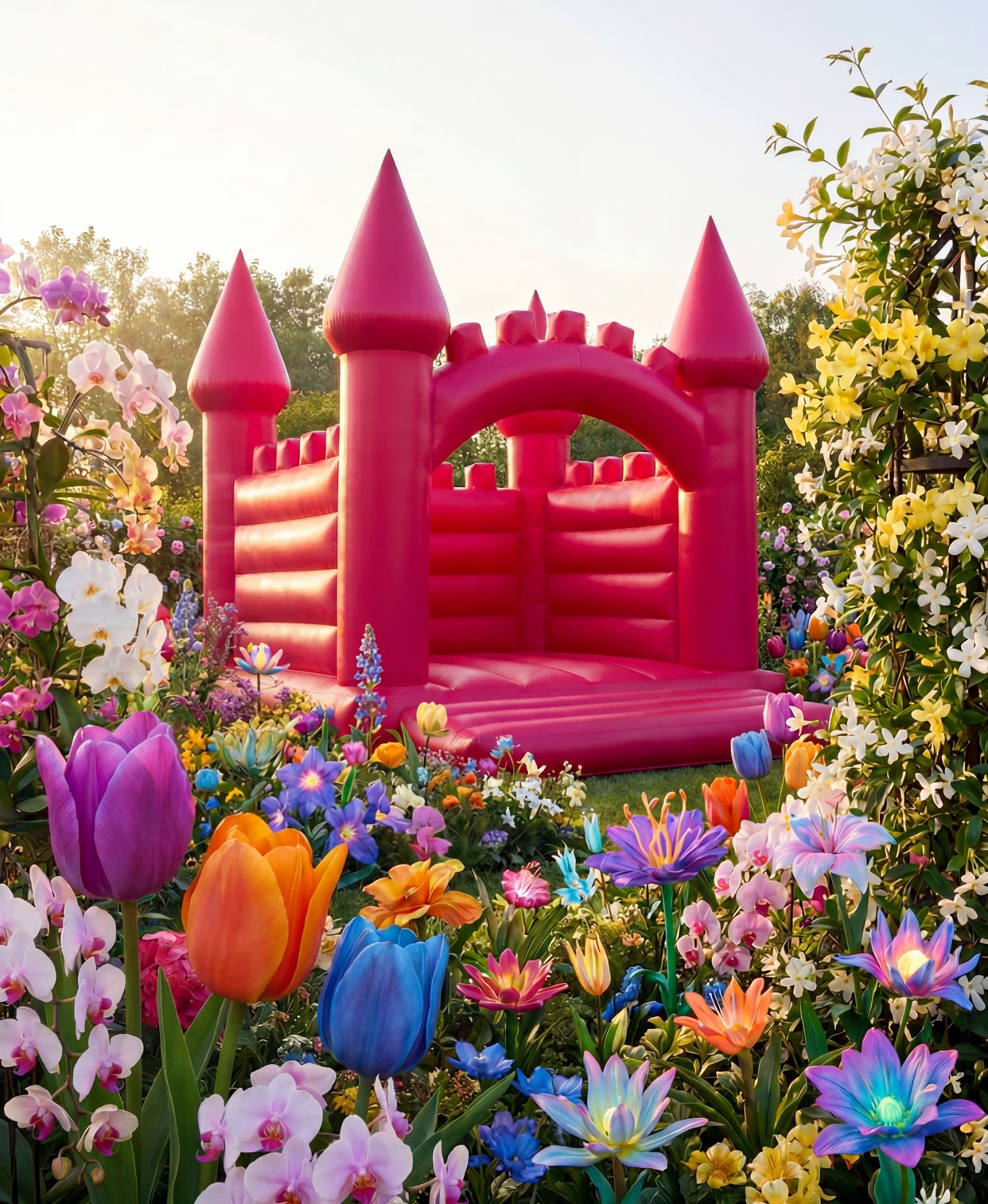
What I know is that whenever life gets heavy enough, I go there in my mind. I jump as high as I can. I laugh until my belly hurts. I am so full of glee that everything I’m worried about in real life simply stops existing for a little while.
It is the purest kind of joy I know how to access.
Or at least it used to.
Because it’s been a long time since I last went there. I actually forgot about it entirely.
Which feels important somehow.
I think motherhood has a way of rearranging the entire internal architecture of a woman so completely that she loses access to rooms she didn’t even realise she hadn’t visited in a while.
And then sometimes something small opens the door again.
It came back on an ordinary evening, mid-phone call with my mother.
She asked if I was still breastfeeding my eleven-month-old son and when I said yes, she laughed and said “Wow, you’re such an old woman. Why would you still be breastfeeding a toddler? You’re behaving like one of those women who couldn’t have a child for many years and God finally answered their prayers in their old age. They’re the ones who refuse to stop breastfeeding their children.”
She didn’t mean it gently and I wasn’t upset by her comment either because I understand my mother now in ways I didn’t when I was younger. She mothers differently. That is genuinely her philosophy.
“Some mothers mother differently.”
Those were her exact words after travelling thousands of miles to come help me postpartum, after my son was discharged from the NICU.
She said it casually while refusing to change his diaper or bathe him because she thought we bathed him too much.
Some mothers mother differently.
It’s true, of course.
And depending on the day, it lands as either wisdom or the most quietly painful thing a mother could ever say.
Her careless comments generally do not bother me but that evening it sent me somewhere I didn’t expect to go.
I started thinking about nurture. About where it comes from. Whether it’s something you’re born with or something that gets deposited in you the moment you become a mother or whether, for some people, it simply doesn’t arrive.
Because I don’t think nurture and motherhood are automatically the same thing.
Some women become mothers without ever becoming emotionally safe places for their children.
Some provide.
Some sacrifice.
Some endure.
Some survive.
Some perform motherhood beautifully from the outside while leaving emotional bruises nobody else can see.
And some mother from such deep emotional depletion that softness never quite reaches the surface consistently enough to be felt.
None of this makes them monsters. Some of them are doing the absolute best they can with what they were given. Some of them never had softness modelled for them either. Some of them are, in their own way, also little girls who never got what they needed still trying to figure out how to give something they weren’t shown.
Which brings me to the question I keep circling:
What actually makes a person nurturing?
And the question underneath that one, the one I wasn’t expecting to arrive at on an ordinary Tuesday evening:
What does becoming a mother reveal about the way we ourselves were mothered?
I don’t think I’m the only one who has stood in the middle of early motherhood and suddenly, unexpectedly, started doing emotional archaeology on their own childhood.
There is something about the intimacy of caring for a baby, the skin-to-skin, the feeding at 3am, the way you instinctively press your lips to their forehead, the things you give without thinking that cracks something open. And in that opening, things surface. Not always dramatically. Sometimes just quietly, in the background of an ordinary day.
You find yourself doing something tender for your child and thinking: I needed this too.
You find yourself protecting them from something and realising: No one protected me from that.
Motherhood has a way of introducing you to the child you once were.
Not metaphorically.
Literally.
She appears in flashes. In your tenderness. In your triggers. In the things you give your child without hesitation. In the things you suddenly recognise as absences in your own story.
And I think that is why early motherhood can feel so emotionally disorienting in ways that have nothing to do with sleep deprivation or feeding schedules.
Because while you are raising someone else, parts of you are quietly being raised alongside them.
And that is when the red bouncing castle came back.
Not the way it usually does.
Usually I go there intentionally. I choose it. I step inside, I jump, I laugh, I let everything fall away. A door I open when I need to.
This time I didn’t open anything. The door simply appeared.
And when it did, I wasn’t inside.
I was standing outside. Present-day me. Looking in.
And for the first time, I saw who had been doing the jumping all along.
It wasn’t the me I thought it was.
It was a little girl.
Has it always been a little girl?!
She was jumping as high as she could go, laughing that uninhibited full-body laugh that children do before they learn to hold themselves back. She wasn’t thinking about anything. She wasn’t worried about anything. She was just there, completely and entirely there in the most joyful version of herself.
I stood outside and watched her and felt something crack open in my chest that I don’t quite have language for yet.
Has it always been her in there?
Or did the questions about nurture and mothers and little girls who grow up wondering call her forward today in a way that hadn’t happened before?
I genuinely don’t know.
What I keep coming back to is this:
Somewhere inside me, there is a little girl in a red bouncing castle who has been carrying my joy this whole time.
Keeping it safe. Keeping the garden lush. Keeping the castle bright and the laughter ready.
And I spent years going there thinking it was present-day me who got to feel that free.
But maybe I was always borrowing her joy.
Maybe she is the one who remembers what it felt like before things got complicated. Before mothers said things that stung quietly. Before you learned that the world doesn’t always protect the things you love most.
She kept jumping through all of it.
Maybe nurture is not something some women simply have and others don’t.
Maybe it is capacity.
Maybe it is modelling.
Maybe it is what happens when softness has somewhere safe to land.
Maybe some women arrive at it naturally because someone taught them consciously or not that tenderness is allowed. That a child’s needs are worth meeting. That love is supposed to feel like safety.
And maybe others have to painstakingly teach it to themselves in adulthood. Piece by piece. Often while simultaneously trying to give it to someone else.
Maybe that is its own kind of extraordinary.
I don’t know what it means that I’m standing outside the castle now instead of in.
I don’t know if that’s growth or grief or some version of both. I don’t know if I’ve lost something or finally found something. I don’t know if I’m supposed to go in and jump with her or simply stand here, grateful she exists, grateful she has been there all this time keeping my joy alive when I forgot to tend to it myself.
I don’t know if my mother was the best mother for me or simply the one I had.
I don’t know if the women who mother differently are broken or depleted or shaped by their own unloved childhoods in ways that were never their fault either.
I don’t have a neat conclusion about mothers and daughters and nurture and the things that get passed down whether we mean them to or not.
Only this, I think becoming a mother forces many women to meet the child they once were.
And in that meeting, in that strange, disorienting, tender collision between who you are now and who you used to be, something becomes possible.
Not resolution, necessarily.
Not forgiveness on a timeline.
Not even answers.
But maybe the beginning of understanding what you needed.
And maybe slowly, imperfectly, in the middle of everything else, the chance to make sure your child doesn’t have to go looking for theirs.
The little girl in the red bouncing castle is still jumping.
I saw her today for the first time.
I’m not sure I know what to do with that yet.
But I saw her.
And I think that matters more than I currently have words for.
ෆ
figuring it out,
Lade
Still in the trenches? Come sit with us in the Village Square (aka Subscriber chat).
No judgment. No perfection. Just mamas figuring it out together🤎

The line that is staying with me: while you are raising someone else, parts of you are quietly being raised alongside them. That is the whole of it. That is the thing I keep trying to say and you just said it in one sentence.
"There is something about the intimacy of caring for a baby, the skin-to-skin, the feeding at 3am, the way you instinctively press your lips to their forehead, the things you give without thinking that cracks something open" As I do these things I wonder, was that how my mom was with me when I was a tiny baby? And what makes some people hard and unapproachable with time if we start with the same tenderness? Or do we moms, start at the same place? how does culture, experience, daily trials of life affect mothering?